
Tibial Plateau Leveling Osteotomy (TPLO)
When your dog suffers a cranial cruciate ligament (CCL) tear, the path forward can feel overwhelming. Dr. Mark Tonzing provides gold-standard TPLO surgery focused on fast recovery, uncompromised safety, biomechanical stability, and getting your best friend back to an active, pain-free life.
Return to Function
TPLO is the gold standard, with consistently superior long-term limb function and athletic restoration compared to other techniques.
Eliminates Shear Force
By flattening the slope of the shin bone, TPLO neutralizes joint shear force as your dog bears weight, negating the need for artificial ligaments.
Hospital-Grade Safety
Every procedure is supported by advanced MindRay anaesthetic machines with integrated multi-parameter monitors and auto-ventilators.
Understanding Cruciate Ligament Tears
The cranial cruciate ligament in dogs is functionally equivalent to the anterior cruciate ligament (ACL) in humans. If your dog has suddenly started limping or holding their back leg up, they may have torn this vital stabilising band.
Unlike humans who usually tear this ligament through sudden athletic trauma, canine CCL disease is predominantly a chronic, degenerative condition. It is associated with progressive fibre fatigue, stifle synovitis, and secondary osteoarthritis. Eventually, even a normal activity like jumping off the couch can cause the weakened ligament to completely snap.
Once the ligament tears, the knee joint becomes highly unstable. Because a dog’s knee joint is never level (it sits at a steep downward angle), every time your dog bears weight, the femur bone slides backward down that slope. This sliding action causes intense pain and rapidly accelerates debilitating arthritis.
How Does the TPLO Fix It?
Because dogs stand on their toes with their knees permanently bent, the forces on their knees are immense. Simply trying to sew the torn ligament back together does not work.
The TPLO changes the physics of the joint entirely. Dr. Tonzing makes a precise, curved radial cut in the top of the shin bone (tibia) and rotates the joint surface until it is almost level (typically to a 5-7 degree angle). He then secures it in place with a specialised titanium or stainless steel locking plate. Once this biomechanical slope is neutralised, cranial tibial thrust is eliminated. The knee becomes inherently stable under the dog's own body weight.
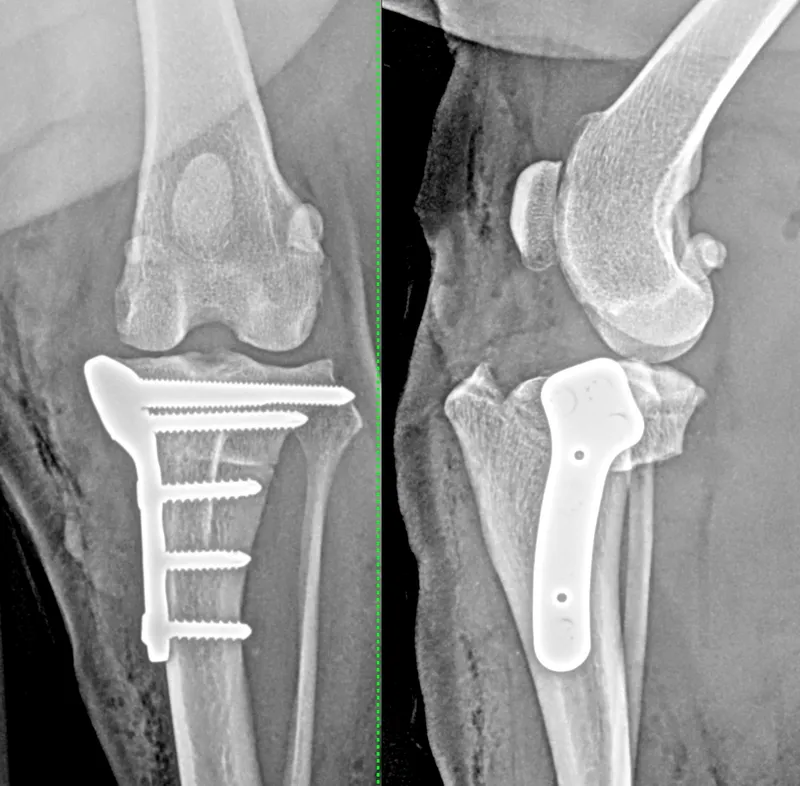
Post-operative radiograph demonstrating precise bone plate and screw fixation following a TPLO procedure at BoneVet.
Comparing the Surgical Options
If you are researching cruciate repair, you will likely encounter an alphabet soup of alternative procedures like TTA, CBLO, TTO, and ECR (Lateral Suture). At BoneVet, our surgical protocols are driven strictly by objective, peer-reviewed veterinary literature. Here is what the science dictates:
TPLO vs. Extra-Capsular Repair (Lateral Suture)
Traditional "tie-back" methods (ECR) rely on heavy synthetic lines around the outside of the joint to mimic the torn ligament. In active, medium, or large-breed dogs, these lines are highly prone to cyclical fatigue, stretching, or snapping under load.
The Verdict: Objective kinetic data (e.g., Au et al., 2010) demonstrates that osteotomies like the TPLO provide superior long-term limb function and a significantly slower progression of osteoarthritis compared to ECR in medium to large dogs.
TPLO vs. TTA (Tibial Tuberosity Advancement)
The TTA neutralises thrust by advancing the patellar tendon forward, utilising the Maquet principle. However, as long-term data matured, significant concerns emerged.
The Verdict: Extensive retrospective studies (such as Hans et al., 2017) have proven that TTA is associated with significantly higher rates of major complications and late-term meniscal tears compared to TPLO. For this reason, its use has steeply declined among surgical specialists.
When do we recommend a CBLO instead?
The CORA-Based Leveling Osteotomy (CBLO) is a modern evolution that shares the exact same goal as the TPLO, but the bone cut is made further down the shin bone, away from the joint. We actively perform the CBLO, but we reserve it for two highly specific anatomical challenges:
- Growing Puppies: Because the cut is lower, it safely bypasses the active growth plates in juvenile dogs, preventing stunted growth.
- Extreme Bone Angles: For dogs born with an excessively steep tibial plateau angle (eTPA), the geometry of the CBLO allows us to safely level the knee without compromising the structural integrity of the bone.
Dive deeper into the clinical data
Read our comprehensive reviews of the published veterinary literature comparing TPLO, TTA, ECR, and CBLO outcomes.
The TPLO Recovery Timeline
What to expect after bringing your pet home.
The Critical Rest Phase
Your dog will come home with highly effective multimodal pain relief. They may begin gently tapping their toe to the ground, but strict confinement is mandatory. Absolutely no running, jumping, stairs, or free roaming. Toilet breaks must be short and always on a leash.
Rebuilding Confidence
You will notice a significant improvement in their comfort. They will be actively using the leg at a walk. We will guide you through gentle, controlled physiotherapy exercises (like slow leash walks and sit-to-stand movements) to begin rebuilding their lost muscle mass.
Radiographic Sign-Off
At this stage, we take follow-up X-rays to confirm the bone has achieved clinical union (healed). Once Dr. Tonzing gives the all-clear, you can gradually reintroduce them to off-leash play and longer, more vigorous activities.

Expert Surgery, Independent Care
Dr. Mark Tonzing BVSc(Hons) MACVSc(SA Surgery)
Operating out of Bardon Veterinary Hospital, BoneVet gives pet owners direct access to advanced orthopaedic and neurosurgical procedures without the rigid overhead or referral bureaucracy of corporate centers. Dr. Tonzing brings decades of surgical experience and precision-focused technique to every procedure.
Learn more about Dr. Tonzing →Frequently Asked Questions
Is TPLO surgery worth the cost for an older dog?
Age is not a disease. If an older dog has healthy organ function and good overall vitality, a TPLO can dramatically improve their quality of life. Resolving the chronic pain and instability of a torn cruciate ligament allows senior dogs to stay active, which is vital for their cardiovascular and mental health.
Do I need a referral to book a TPLO consultation?
No. While we gladly accept direct referrals from general practice clinics across Greater Brisbane, pet parents are welcome to contact BoneVet directly. We provide transparent, evidence-based second opinions and surgical estimates for families seeking state-of-the-art care.
What happens if the cruciate tears in the other leg?
Unfortunately, because cruciate disease is often a degenerative condition linked to genetics and bone angles, approximately 40-50% of dogs will eventually tear the ligament in their opposite leg. This makes it incredibly important to repair the first leg perfectly with a TPLO, ensuring they have a strong, stable "good leg" to rely on if the other one fails.
Ready to discuss your pet's surgery?
Whether you have received a high estimate elsewhere or your local vet has recommended a surgical review, book a direct consultation with our surgical team today.