
Cranial Cruciate Ligament Insufficiency
A Review of Surgical Management Options
Cranial cruciate ligament (CCL) insufficiency remains the most common cause of hindlimb lameness in the canine patient. Unlike the acute traumatic ACL ruptures commonly seen in humans, canine CCL disease is predominantly a chronic, degenerative condition associated with progressive fibre fatigue, stifle synovitis, and secondary osteoarthritis.
The primary biomechanical goal of surgical intervention is to neutralise cranial tibial thrust during the stance phase of the gait cycle. While numerous techniques exist, they broadly categorise into dynamic stabilisation (osteotomies) and passive stabilisation (extracapsular repairs). Below is a review of the current modalities.
TPLO (Tibial Plateau Leveling Osteotomy)
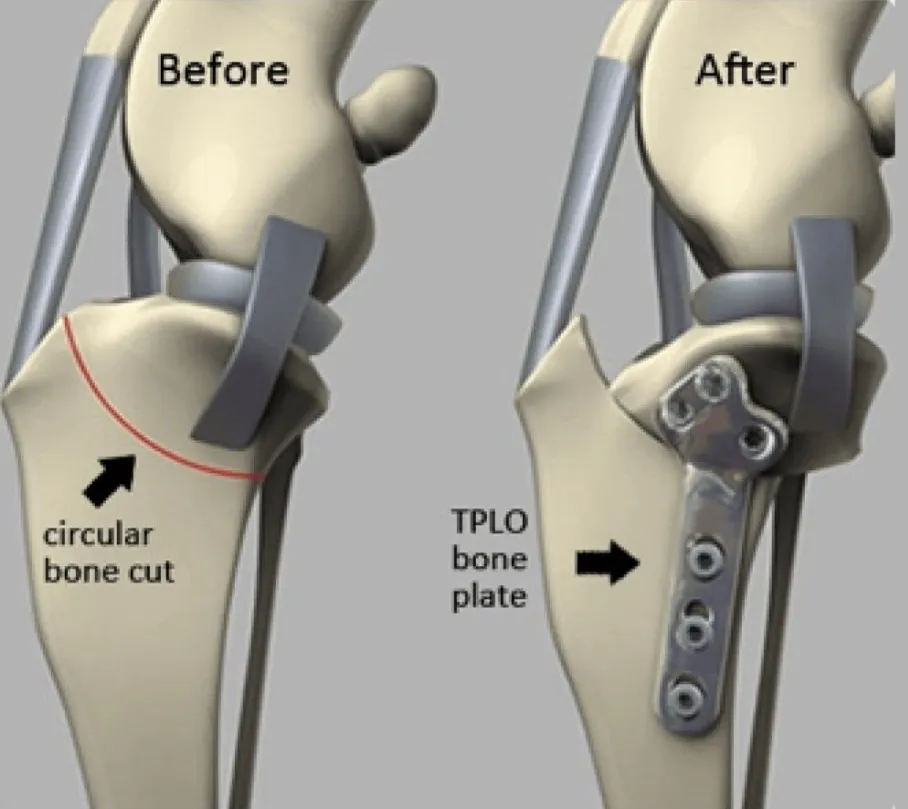
Considered the gold standard by the majority of board-certified veterinary surgeons, TPLO alters the geometry of the stifle by rotating the proximal tibial segment following a radial osteotomy. By levelling the tibial plateau to an angle of approximately 5-7 degrees, cranial tibial thrust is neutralised, converting shear forces into compressive joint forces.
Clinical Consensus: TPLO provides a consistently rapid return to function and superior long-term limb use, particularly at the trot, compared to extracapsular techniques. Furthermore, comprehensive systematic reviews demonstrate TPLO yields a significantly lower rate of major and late-term complications (including late meniscal tears) compared to TTA.
CBLO (CORA-Based Leveling Osteotomy)
CBLO represents a modern evolution in levelling osteotomies. While sharing the objective of neutralising cranial tibial thrust, the radial osteotomy is centred over the bone's Center of Rotation of Angulation (CORA), located further distal to the tibial plateau compared to a TPLO.
Clinical Indications: While TPLO remains the primary choice for standard presentations, CBLO offers distinct anatomical advantages. Because the osteotomy is distal to the proximal tibial physis, it is highly advantageous in juvenile patients with open growth plates. It is also an excellent modality for addressing excessive Tibial Plateau Angles (eTPA), allowing for significant slope correction without compromising the structural integrity of the proximal tibia.
TTA (Tibial Tuberosity Advancement)
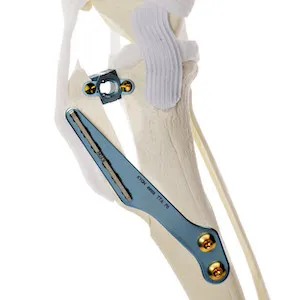
TTA neutralises cranial tibial thrust by advancing the insertion of the patellar tendon until it is perpendicular to the tibial plateau slope, utilising the Maquet principle. Variations include standard caged TTA, MMP (Modified Maquet Procedure using titanium foam), and TTA Rapid.
ECR (Extra-Capsular Repair / Lateral Suture)
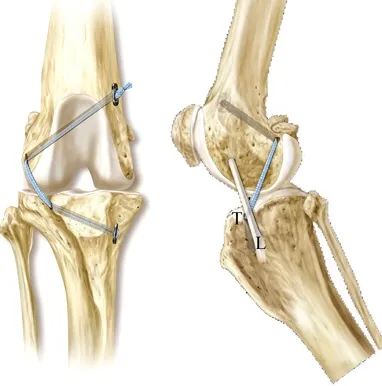
Passive stabilisation techniques, such as the Lateral Fabellar Suture, aim to replicate the function of the intact CCL using heavy monofilament nylon or ultra-high-molecular-weight polyethylene (e.g., TightRope, IPLS). The prosthesis is anchored from the lateral fabella to the proximal tibial crest.
Limitations: While often sufficient for small breeds or low-activity patients, extracapsular repairs are prone to premature stretching, cyclical fatigue, and altered joint kinematics. Objective kinematic data (e.g., Au et al., 2010) demonstrates that osteotomies (TPLO) provide superior long-term limb function and slower progression of osteoarthritis compared to ECR in medium to large dogs.
TTO (Triple Tibial Osteotomy)
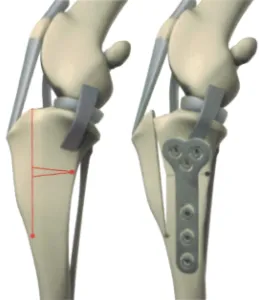
TTO attempts to combine the mechanics of both a TTA and a closing wedge osteotomy. The procedure involves three separate bone cuts to advance the tuberosity while simultaneously reducing the plateau angle.
Clinical Consensus: There is a distinct paucity of objective, peer-reviewed kinetic or kinematic data supporting the efficacy of TTO over TPLO. Given the inherently higher surgical morbidity associated with three distinct osteotomies and the lack of comparative evidence proving superior outcomes, TTO is difficult to justify as a primary recommendation.
Selected Literature & References
- Duerr et al. (2014) "Treatment of canine cranial cruciate ligament disease: A survey of ACVS Diplomates..." Vet Comp Orthop Traumatol. (71% of surgeons prefer TPLO).
- Hans et al. (2017) "Comparison of complications following TTA and TPLO in dogs with cranial cruciate ligament disease..." Vet Surg. (Higher late major complication rates in TTA).
- Au et al. (2010) "Comparison of short- and long-term function... after TPLO or lateral fabellar suture stabilization." Vet Surg. (Superior long term function with TPLO).